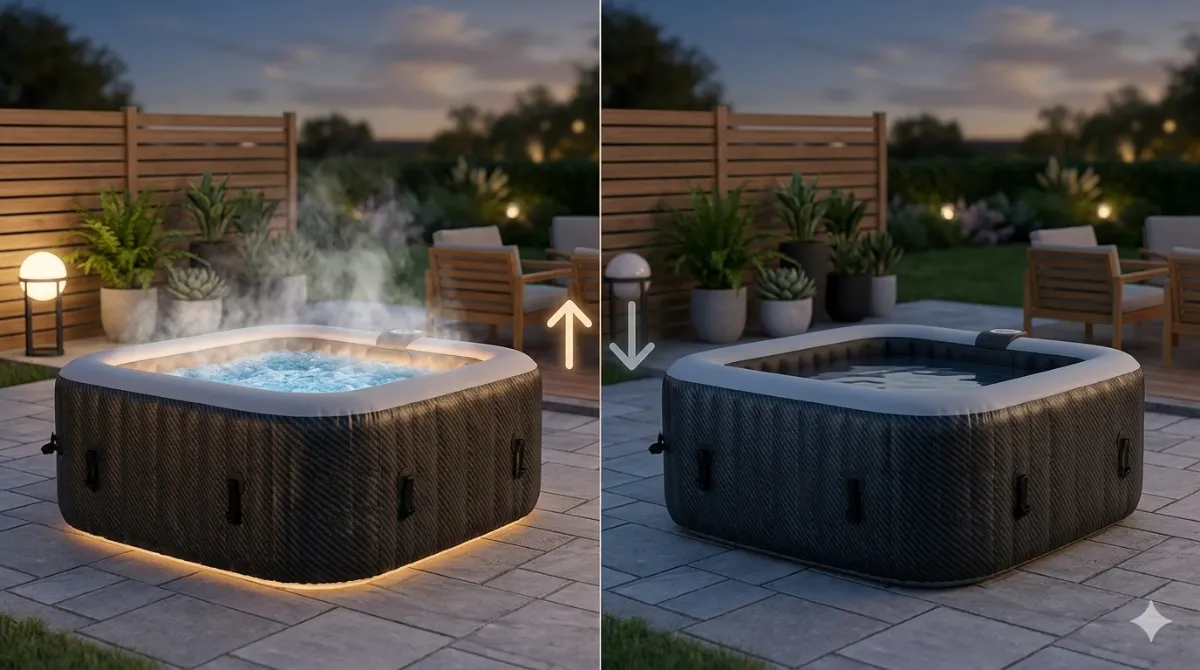
You’ve set up your inflatable hot tub, heated it for the first time, and had a great soak. Now you’re standing there wondering: do I leave this running, or switch it off until next time?
It’s one of the most common questions Canadian spa owners face and the answer isn’t simply “always on” or “always off.” It depends on how often you use your spa, what season you’re in, and how your energy costs are structured. Getting this decision right has a real impact on your monthly electricity bill and on how long your spa equipment lasts.
The Case for Leaving Your Inflatable Hot Tub On
For most Canadian spa owners who use their hot tub regularly say, three or more times per week leaving it running continuously is almost always the more efficient choice. Here’s why.
Reheating cold water is expensive. Heating 800 to 1,000 litres of water from cold tap temperature (8°C to 15°C in a Canadian winter) up to 40°C is one of the most energy-intensive tasks your spa performs. The heater runs at full output for 20 to 30 hours straight. Doing that repeatedly every time you want a soak costs significantly more than the energy required to simply maintain temperature between uses.
The physics is straightforward: maintaining 38°C requires short, infrequent heating bursts to top up the temperature lost through the cover. Reheating from cold requires sustained maximum heater output for an entire day or more. Unless you’re leaving the spa unused for a week or longer, the reheat cost almost always exceeds the maintenance cost.
Water chemistry stays more stable. A spa that’s continuously running its filtration cycles maintains consistent water circulation, which keeps sanitiser distributed evenly and prevents the stagnation that allows bacteria to develop. Every time you drain and refill, you’re starting your water chemistry from scratch retesting, re-dosing, and waiting for the water to balance before it’s safe to use.
Your equipment lasts longer with steady operation. Repeatedly powering down and restarting a pump and heater creates more mechanical stress than continuous low-level operation. Consistent circulation keeps seals lubricated and prevents the kind of thermal cycling that stresses plastic and rubber components over time.
When Turning It Off Makes Sense?
Leaving a hot tub running continuously isn’t the right answer in every situation. There are specific circumstances where powering down or at minimum dropping to a very low maintenance temperature is the smarter choice.
Extended absences of a week or more. If you’re away on holiday or the spa won’t be used for ten days or longer, keeping it running at full temperature is genuinely wasteful. This is exactly what vacation mode is designed for dropping the set temperature to around 20°C maintains enough warmth to protect components and prevent freezing in mild conditions, while significantly reducing heater activity.
In severe Canadian winter conditions sustained temperatures below -15°C even vacation mode needs careful management. If your spa has Freeze Shield® technology, it will override the low temperature setting and activate the heater automatically when temperatures approach freezing. In truly extreme cold without this protection, the safest option is a full drain and dry rather than a low-temperature hold.
End of the outdoor season. If you genuinely won’t use your spa for two to three months perhaps you’re storing it for winter or relocating a full drain, clean, and dry storage is the appropriate choice. Leaving an inflatable hot tub running unmonitored through a Canadian winter while you’re not actively checking it is a risk not worth taking.
Very infrequent use once a week or less. If you soak only once every week or two, the calculation shifts. At that frequency, the cost of maintaining temperature continuously may approach or exceed the cost of reheating from a lower temperature.
This is where economy mode becomes your best tool not a full shutdown, but a reduced temperature hold at around 30°C that slashes maintenance heating costs while keeping reheat time to two to four hours rather than a full day.
Should You Leave Your Inflatable Hot Tub On Overnight?
Yes for most Canadian users, overnight is actually when the insulated cover earns its keep most clearly. Overnight air temperatures in Canada drop significantly, particularly in spring and autumn when daytime temperatures are comfortable but nights turn cold.
A well-insulated spa with its cover properly fitted loses temperature slowly overnight typically 1°C to 2°C over eight hours in moderate conditions. The heater runs briefly during the night’s filtration cycle to compensate. When you wake up, the spa is still at or very close to your set temperature and ready to use within minutes.
The alternative turning the spa off at night and reheating each morning is a poor trade-off for any spa used more than occasionally. You’d be running the heater at full output for several hours every morning, paying more in electricity and waiting longer to soak.
Can You Leave an Inflatable Hot Tub Outside in Canadian Winters?
This is a related question that Canadian owners ask frequently, and the answer is a conditional yes with the right preparation.
An inflatable hot tub with Freeze Shield® auto-protection, an EnergySense® insulated cover, and a sheltered placement can operate reliably through Canadian winters in most provinces. The spa’s freeze protection system monitors temperature and activates heating automatically when conditions approach dangerous levels.
What you cannot safely do is leave an inflatable hot tub outside, powered off, with water in it, through a Canadian winter. Water expands when it freezes. Frozen water inside the pump, pipes, and tub shell causes serious and often irreparable damage. If you’re not keeping the spa running and monitored through winter, drain it completely, dry every component, and store it indoors.
The Pros and Cons at a Glance
A quick overview highlighting the key advantages and disadvantages to help you make a fast, informed decision at a glance.
| Situation | Best Approach | Why |
|---|---|---|
| Using 3+ times per week | Leave on at set temp | Cheaper than repeated reheating |
| Using once or twice a week | Economy mode at 30°C | Reduces maintenance cost, short reheat |
| Away for 1–2 weeks | Vacation mode (20°C) | Saves energy, protects from freezing |
| Away for a month or more | Full drain and storage | Prevents freeze damage and wasted energy |
| Canadian winter, regular use | Leave on with cover | Freeze Shield handles cold snaps |
| Canadian winter, not using | Drain, dry, store indoors | Only safe option without active monitoring |
What This Means for Your Electricity Bill ?
The cost of leaving a hot tub on all the time in Canada varies by province and season, but maintaining a well-insulated spa at a consistent temperature typically costs between $1 and $3 CAD per day in electricity. That’s $30 to $90 per month for a spa that’s always ready when you want it.
Reheating from cold costs roughly $4 to $8 CAD per full heat cycle, depending on starting water temperature and ambient conditions. If you’re doing that twice a week because you keep shutting the spa off, you’re spending more than continuous maintenance costs and waiting 24 hours each time before you can soak.
The break-even point, where reheating becomes cheaper than continuous maintenance, typically sits at usage less than once every ten days in summer conditions, or less than once every two weeks in winter. Below that frequency, economy mode bridging is still more efficient than full shutdowns.
Conclusion
For most Canadian inflatable hot tub owners, the answer to “should I leave my inflatable hot tub on all the time” is yes with a well-insulated cover, a sensible temperature setting, and economy mode for slower-use periods.
The cost of maintaining warmth is consistently lower than the cost of reheating from cold, and continuous operation keeps water chemistry stable and equipment running smoothly.
At Relxtime, our EnergySense®-equipped SaluSpa models are built to hold temperature efficiently between uses, so leaving them running makes practical and financial sense through every Canadian season.
Frequently Asked Questions?
Here are some frequently asked questions given below:
Is it cheaper to leave an inflatable hot tub on or turn it off between uses?
For spa owners using their tub three or more times per week, leaving it on at a consistent temperature is almost always cheaper than reheating from cold. Reheating a full tub from cold Canadian tap water costs more in electricity than maintaining temperature continuously over the same period.
Should I leave my inflatable hot tub on overnight in winter?
Yes. Overnight is when heat loss is highest due to falling temperatures. A well-insulated cover keeps temperature loss minimal, and the heater runs only brief cycles to compensate. Turning off overnight and reheating each morning costs more and adds a long wait before you can use the spa.
What temperature should I leave my hot tub at when not in use?
For regular use, maintain your target soaking temperature or drop 2°C to 3°C below it. For infrequent use, economy mode at around 30°C reduces maintenance costs while keeping reheat time to a few hours. For extended absences in mild weather, vacation mode at 20°C is appropriate.
Can leaving a hot tub on all the time damage it?
No inflatable hot tubs are designed for continuous operation. Consistent low-level circulation is actually gentler on pump seals and heater elements than repeated start-stop cycles. Regular filter maintenance and water chemistry checks remain important regardless of operating mode.
What should I do with my inflatable hot tub during a Canadian winter if I’m not using it?
If you’re actively monitoring it, keep it running with freeze protection active and the insulated cover on. If you’re leaving it unattended for more than a couple of weeks in freezing temperatures, drain it completely, dry every component thoroughly, and store it indoors. Never leave a powered-off spa with water in it through a Canadian winter.